A quick starting point
Pick one scene, read its ending and leave a pause. Your child can listen, join a quiet pretend gesture, ask for another scene or stop. Around age 2, listening or one familiar action can be enough; around ages 3–5, an interested child might repeat a line or invent a different ending. These are flexible choices, not humor milestones.
Banana call
Sock crown
Shoe wings
Book house
Ordinary objects, very imaginary jobs. All 20 endings are written below.
View the complete picture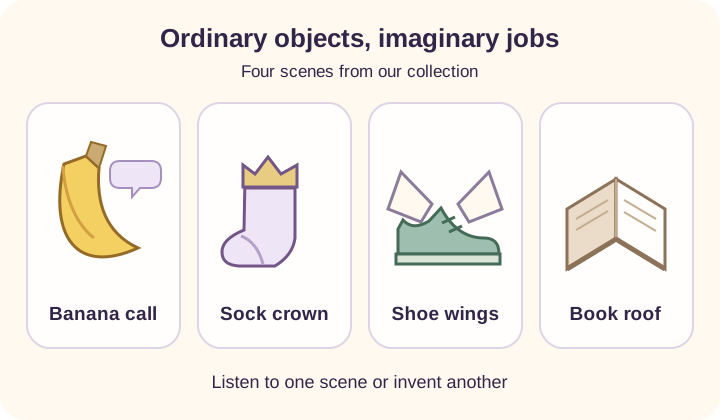
Make the pretend idea clear
Say, “In this pretend joke, the sock thinks it is a king.” Read the paragraph marked “Read aloud,” including its ending. The explanation is for you; choose the shorter version whenever that feels easier. A gesture is optional. You can repeat a line or explain an unfamiliar object without asking, “Do you get it?”
A PBS parent article offers examples of physical, action-based silliness as well as wordplay in family humor. PBS: family humor ideas. Our scenes use optional quiet gestures and complete endings; they do not claim that a particular age will find a joke funny or that these jokes improve a measured skill.
- All props and characters are imaginary. Empty hands and an ordinary speaking voice are enough.
- No child, body, accent, mistake or family member is the target of the joke. The comic change happens to a pretend object or scene.
- A smile, a different ending, quiet listening or “no more” is welcome. No laugh count or completion target is needed.
1–5: ordinary objects get new jobs
Start with familiar objects. Read the first paragraph aloud; the explanation, shorter option and gesture are there for you to choose.
The banana call
Read aloud: Banana makes an imaginary phone call. “Is this the fruit bowl?” “No,” says Sock. “It’s the laundry basket!” Banana sighs. “Oops. I called the wrong bowl.”
Why it’s silly: Banana mixes up two familiar places that hold things.
Short version: Banana calls the fruit bowl. Sock answers from the laundry basket. Oops!
Optional gesture: Make one soft ring with your voice, or listen.
The sock crown
Read aloud: Sock puts on a little crown. “I’m king of the laundry!” “Where’s your throne?” asks Towel. “In the washing machine,” says Sock. “It spins!”
Why it’s silly: The royal seat is an imaginary spinning wash.
Short version: Sock is a king. Its throne goes round and round!
Optional gesture: Give a tiny royal bow with empty hands.
The shoe’s wings
Read aloud: Shoe shows off two paper wings. “Watch me fly!” Boot waits. Shoe whispers, “Could you carry me? My wings forgot how.”
Why it’s silly: Shoe expects paper wings to work, then asks for a lift.
Short version: Shoe has wings. It still needs someone to carry it!
Optional gesture: Spread empty hands like wings, then rest them.
The book’s house
Read aloud: Pencil knocks on Book’s little paper house. “May I come in?” “Yes,” says Book. “Wipe your feet. I just cleaned page one!”
Why it’s silly: Book treats its first page like the floor of a house.
Short version: Book has a house. Its floor is page one!
Optional gesture: Make a roof with empty hands.
The cup’s new hat
Read aloud: “I’m a hat today!” says Cup. “Then why are you full of juice?” asks Plate. “Oops,” says Cup. “That would be a very wet hairdo!”
Why it’s silly: Cup changes jobs but forgets about the drink inside.
Short version: Cup wants to be a hat. Oops, it is full of juice!
Optional gesture: Point above your head without putting anything there.
6–10: a tiny forecast and a grand cape
Try a quiet voice for the big announcement. The surprise comes from what the imaginary object says or does.
The umbrella’s one drop
Read aloud: Cloud sends one tiny pretend raindrop toward Flower. Umbrella opens wide. “Did I keep you dry?” “Yes,” says Flower. “But the raindrop missed me anyway!”
Why it’s silly: Umbrella prepares for a big rain when there is only one drop.
Short version: One little drop. One big umbrella. The drop misses!
Optional gesture: Trace one small drop in the air.
Captain Couch’s cape
Read aloud: “I’m Captain Couch’s cape!” announces Blanket. “Can you fly?” asks Cushion. “No,” says Blanket. “But I can rescue cold knees.”
Why it’s silly: The grand superhero has an ordinary cozy job.
Short version: Blanket is a superhero. It rescues cold knees!
Optional gesture: Give a quiet superhero announcement; keep your hands free.
The spoon’s concert
Read aloud: Spoon announces, “Tonight I’ll sing!” Bowl settles in. Spoon sings, “Soup, soup, soup.” “Do you know another song?” asks Bowl. “Yes. More soup!”
Why it’s silly: The kitchen performer can only think about soup.
Short version: Spoon sings, “Soup, soup.” Its next song is “More soup!”
Optional gesture: Stir an empty hand gently, then pause.
The box bus
Read aloud: “All aboard my imaginary bus!” says Box. “Where are the wheels?” asks Chair. “At home,” says Box. “We will have to walk.”
Why it’s silly: The bus cannot do its job without wheels, so its passengers walk.
Short version: Box is a bus. No wheels? Everybody walks!
Optional gesture: Walk two fingers slowly across your own palm.
The flower’s hat
Read aloud: “I have a leaf hat,” says Flower. “What happens when the wind blows?” asks Bee. Flower looks up. “My hat goes for a walk without me!”
Why it’s silly: The loose leaf moves while the flower stays in place.
Short version: Flower’s hat blows away. The hat takes a walk!
Optional gesture: Let one empty hand drift slowly.
11–15: pretend visitors and letters
These characters can talk and write because this is pretend. If a picture, suitcase or postcard is unfamiliar, use its short version or choose another scene.
Moon’s daytime visit
Read aloud: “I’m visiting Sun,” says Moon. “What will you wear?” asks Star. “My pajamas,” says Moon. “It’ll be daytime, but I’m still sleepy!”
Why it’s silly: The pretend moon brings its nighttime clothes to a daytime visit.
Short version: Moon visits Sun in pajamas. “I am still sleepy!”
Optional gesture: Rest your cheek on empty hands for a moment.
Turtle’s suitcase
Read aloud: “I packed for my trip,” says Turtle. Rabbit looks into the empty suitcase. “Where are your things?” “At home,” says Turtle. “I packed room for souvenirs!”
Why it’s silly: Turtle calls an empty suitcase completely packed.
Short version: Turtle’s suitcase is empty. “Lots of room for my trip!”
Optional gesture: Open empty hands like a small suitcase.
Bear’s tiny chair
Read aloud: Bear points to a tiny drawing of a chair. “I’ll sit here.” “You won’t fit,” says Owl. “I won’t,” says Bear. “But my picture will!”
Why it’s silly: Bear switches from itself to a small picture of itself.
Short version: A tiny chair for a tiny picture of Bear. Just right!
Optional gesture: Make a small space between empty hands.
Cloud’s shopping bag
Read aloud: “What’s in your bag?” asks Wind. “A breeze,” says Cloud. Wind peeks inside. “It’s empty!” “Oh no,” says Cloud. “My shopping blew away!”
Why it’s silly: The pretend breeze escapes from an open shopping bag.
Short version: Cloud buys a breeze. Whoosh, it blows out of the bag!
Optional gesture: Let one hand drift out of a pretend bag.
Pillow’s letter
Read aloud: Pillow writes, “Dear Bed, I’ll be late.” “Late for what?” asks Bed. “I’m right beside you!” Pillow pauses. “Then this letter arrived very quickly.”
Why it’s silly: Pillow writes to a neighbor that can already hear it.
Short version: Pillow writes to Bed. Bed says, “I am right here!”
Optional gesture: Make a small writing motion with empty hands.
16–20: a quiet concert and a picture café
Choose one scene rather than trying to finish the list. Silence and a simple change of scale can be part of the pretend story.
A hat for Table
Read aloud: “Please sit on my head,” says Table. “Your head is huge!” says Hat. “Then sit on one corner,” says Table. “I’ll call it a tiny hat day.”
Why it’s silly: Table invents a small hat area instead of finding a bigger hat.
Short version: Big Table. Small Hat. “One corner is enough!”
Optional gesture: Show a wide space, then a small one, with your hands.
The quiet drum
Read aloud: “My first song is called Silence,” says Drum. Stick listens. Nobody makes a sound. “Wonderful!” says Stick. “I can play that one too.”
Why it’s silly: A drum concert begins with no drumming at all.
Short version: Drum plays a silent song. Shh, that is the whole song!
Optional gesture: Take a short, comfortable pause; no breath-holding.
Puddle’s postcard
Read aloud: Puddle sends a postcard with its picture. “Are you going on a trip?” asks Stone. “Only my picture,” says Puddle. “I’m staying here to keep the ground wet.”
Why it’s silly: The picture travels while its pretend puddle stays home.
Short version: Puddle’s picture goes on a trip. Puddle stays on the ground!
Optional gesture: Trace a flat postcard shape in the air.
Ribbon’s measuring day
Read aloud: “Lie straight so I can measure you,” says Ruler. Ribbon curls into a circle. “How long am I?” asks Ribbon. Ruler looks at the loop. “Now I need to bend!”
Why it’s silly: Straight Ruler imagines becoming round to match Ribbon’s new shape.
Short version: Straight Ruler meets round Ribbon. “I need to bend!”
Optional gesture: Trace one broad loop with a finger, without string.
The crayon’s café
Read aloud: “What’s for lunch?” asks Paper. “A red circle and two purple squiggles,” says Crayon. “Can I eat them?” “No. But I can draw dessert!”
Why it’s silly: The pretend café serves pictures instead of food.
Short version: Crayon’s café serves a picture for lunch, and a picture for dessert!
Optional gesture: Draw an imaginary circle in the air.
Let a child change the ending
If your child likes the box bus, ask, “Should it have imaginary wheels or imaginary wings?” They can choose, point or let you answer. Read the new version with the same comfortable pace. It does not have to be clever, surprising or even a joke; choosing a plain story ending works too.
Try a familiar switch: the sock becomes a pretend chef instead of a king. Ask what its new job might be and accept the answer. Do not correct a child’s joke or keep asking for laughter. If the change is distracting, return to the written scene or stop.
Use the support that feels comfortable
Around ages 2–3, name one familiar object and use the short version under any scene. A child can listen or copy a small gesture. Around ages 4–5, an interested child might choose a character voice, share a line or propose a different ending. A child of any age can prefer the shorter version; these are options, not milestones.
The Spanish page preserves these complete little scenes in Spanish with its own dialogue. Choose the language you share comfortably. You can explain banana, sock or ribbon in a home language without turning the joke into a translation quiz.
Keep the invitation small
One scene can be the whole activity. If a child seems unsure, describe the ordinary object and then its pretend change; if they want to stop, close the page. Loud voices, surprise tricks, masks and real props are unnecessary. You can read this in a quiet room at any time without promising a bedtime result.
This collection was written and reviewed using AI tools. It has not been reviewed by an education professional or tested with children. It is a written collection for a grown-up to read, with no recorded narration or downloadable joke pack.
A different page can wait for another day
For a complete gentle story, choose one of our three original bedtime stories. Our animal-name activity offers a separate illustrated naming activity. Neither needs to follow the joke immediately.
The Leelalu Games website currently offers three free browser games: Shape Match, Color Match and Big & Small. They include matching and comparing sizes; this page is a separate read-aloud collection. You can choose a game another time or finish after one scene.
Questions parents ask
Are these riddles with hidden answers?
No. Each scene includes its complete ending and a short grown-up explanation. A child is not required to solve or guess anything.
What if my child does not laugh?
Read it as a short pretend story, change the scene if invited or stop. Humor preferences and comprehension differ; a laugh is not the measure of participation.
Can a 2-year-old join?
You can name one familiar object, read a shorter scene and offer a quiet imaginary gesture. Listening or declining is enough; this is not an age-based humor test.
Do we need a banana, shoe or other prop?
No. The whole activity can use words, the pictured scenes and empty hands. Do not climb into boxes, put objects on a child’s head or treat pretend food as something to eat.
Keep playing together
Sources and context
- Why Being Funny Is Good for Your FamilyAccessed · Source language: English