A quick starting point
Read one main line slowly. Offer the shorter version if your child wants a turn; offer more words only if that sounds fun. At around age 2, listening or making the pretend gesture can be the entire activity. Around ages 3–5, optional repetition or inventing a new ending adds another way to play. Any child can choose the listening version, in English or Spanish.
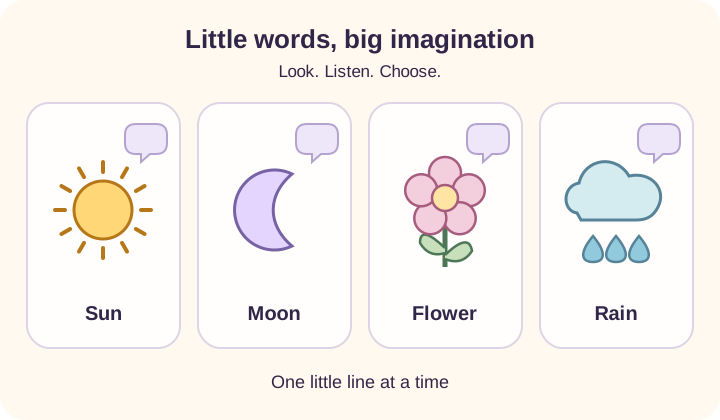
Start with a shared little scene
Read the main line once and describe its pretend picture. You might say, ‘Our sun is stirring imaginary soup.’ Leave a pause. Your child can show you a stirring hand, look at the sun or say nothing. If they want a turn, say the shorter line and wait. Use your usual comfortable voice; quiet or slow speech works. The listed longer lines add words without adding a demand to speak faster.
NAEYC's family guidance invites grown-ups to make up games with sounds and words, including words that begin with the same sound, and to offer books in the home language and English. NAEYC: everyday language play. Our original phrases are one optional way to share that sort of play; this page does not measure a child's speech or teach a tested phonics program.
- Listening is participation. A gesture, a new word, a different ending or a request to stop is welcome.
- If a word is unfamiliar, explain it or use a different line. You do not have to ask a child to repeat your model correctly.
- All props below are imaginary. An empty hand can be a pot, boat or mitten; small objects and recordings are unnecessary.
1–4: Sky and garden tongue twisters
Each line is complete here. Choose one; the shorter or longer line is a choice, not a level you have to pass.
Sunny soup
Say slowly: “Silly Sun slowly stirs a sunny soup.” Shorter: “Silly Sun stirs.” More words: “Silly Sun stirs sunny soup; sunny soup surprises Sun.” Pretend to stir with an empty hand. The soup and the talking sun are make-believe.
Moon's morning
Say slowly: “Mellow Moon mixes mini moons in a mug.” Shorter: “Mellow Moon mixes.” More words: “Mellow Moon mixes mini moons; mini moons miss Moon's mug.” Make a circle with your hands. These tiny moons belong to an imaginary kitchen.
Rainy roof
Say slowly: “Round raindrops roll round Robin's red roof.” Shorter: “Raindrops roll.” More words: “Round raindrops roll round red roofs; red roofs receive round raindrops.” Tap one finger gently on your palm for a pretend raindrop.
Flower fingers
Say slowly: “Five fluffy flowers flutter from Fern's fingers.” Shorter: “Fluffy flowers flutter.” More words: “Fern's fluffy flowers flutter; fluttering flowers fill Fern's fingers.” Open one hand like a flower. The floating flowers are an imaginary picture.
5–8: Animal friends in pretend scenes
Each line is complete here. Choose one; the shorter or longer line is a choice, not a level you have to pass.
Bear's baskets
Say slowly: “Bear brings blue baskets beside brown baskets.” Shorter: “Bear brings baskets.” More words: “Bear brings brown baskets beside blue baskets; blue baskets bump brown baskets.” Point left, then right, as if the two baskets were beside you.
Rabbit's ribbons
Say slowly: “Rabbit wraps round ribbons round a red ribbon roll.” Shorter: “Rabbit wraps ribbons.” More words: “Round ribbons wrap Rabbit's roll; Rabbit's roll rolls round.” Turn one finger in the air. No actual ribbon is needed.
Duck's dots
Say slowly: “A dancing duck draws dark dots down a dotted dock.” Shorter: “Duck dots dots.” More words: “The duck dots the dotted dock; the dotted dock doubles the duck's dots.” Make tiny pretend dots in the air with an empty finger.
Fish's flags
Say slowly: “Funny Fish folds four floppy flags for Frog.” Shorter: “Fish folds flags.” More words: “Four floppy flags fold flat; Frog finds Fish's flat flags.” Bring your palms together, then open them. Fish folding paper is make-believe.
9–12: Boats, bells and soft socks
Each line is complete here. Choose one; the shorter or longer line is a choice, not a level you have to pass.
Bell and bowl
Say slowly: “Bella balances a baby bell beside a blue bowl.” Shorter: “Bella's baby bell.” More words: “Bella's baby bell bobs beside the bowl; the blue bowl bumps Bella's bell.” Tilt an empty palm as a pretend bowl. Keep the bell sound as quiet as you like.
Boat's bubbles
Say slowly: “A bubbly boat bumps by Bob's bobbing buoy.” Shorter: “Bubbly boat bumps.” More words: “Bob's bobbing buoy bumps the boat; the bubbly boat bumps Bob's buoy.” Move one flat hand slowly across the other, like a boat on water.
Kite's cookies
Say slowly: “Kit keeps Kite's cookies in a clean cookie tin.” Shorter: “Kit keeps cookies.” More words: “Kit keeps clean cookie tins; Kite keeps cookies in Kit's tins.” Make an imaginary lid with your hand. There is no eating task.
Sock's spots
Say slowly: “Six soft socks sit in Sam's spotty sock sack.” Shorter: “Soft socks sit.” More words: “Sam's soft socks sit in sacks; spotty sacks shelter Sam's socks.” Point to a sock or imagine one. Counting six is optional.
13–16: Toys on a little adventure
Each line is complete here. Choose one; the shorter or longer line is a choice, not a level you have to pass.
Puppy's purple paper
Say slowly: “Puppy puts purple paper past Pippa's paper pile.” Shorter: “Puppy's purple paper.” More words: “Pippa piles purple paper; Puppy pats Pippa's purple pile.” Stack your empty hands as a pretend paper pile.
Cat's cushions
Say slowly: “Cat carries cozy cushions close to Clara's couch.” Shorter: “Cat carries cushions.” More words: “Clara's cozy cushions cover the couch; Cat carries Clara's cushions close.” Give an imaginary cushion a gentle hug.
Turtle's table
Say slowly: “Tessa's toy turtle turns toward a tiny toy table.” Shorter: “Toy turtle turns.” More words: “Two toy turtles turn toward tables; tiny tables turn toward Tessa's turtles.” Turn your hand slowly. The last line imagines tables that can move.
Lion's little leaves
Say slowly: “Little Lion lays long leaves along Lily's lane.” Shorter: “Lion lays leaves.” More words: “Lily's long leaves line the lane; Little Lion lays little leaves along it.” Draw an imaginary line on the table. These leaves are in a pretend scene.
17–20: More words to play with
Each line is complete here. Choose one; the shorter or longer line is a choice, not a level you have to pass.
Mouse's mittens
Say slowly: “Mouse moves mint mittens from a mini mitten mat.” Shorter: “Mouse moves mittens.” More words: “Mint mittens move from Mouse's mat; Mouse moves the mitten mat, too.” Wiggle your empty hands like mittens.
Pots and lids
Say slowly: “Pat puts pink pot lids past Pip's purple pots.” Shorter: “Pat puts pot lids.” More words: “Pink pot lids pass purple pots; Pip puts purple lids past Pat's pots.” Hold a flat hand above your palm as a pretend lid. No kitchen equipment is needed.
Snail's small shelf
Say slowly: “Snail slides small shells onto a slim shell shelf.” Shorter: “Snail slides shells.” More words: “Small shells slide past Snail's shelf; Snail slides the shelf past the shells.” Slide an empty finger across your palm. Use the shortest line if the words feel crowded.
Bunny's buttons
Say slowly: “Bunny balances big buttons below Bella's button box.” Shorter: “Bunny balances buttons.” More words: “Bella's big button box bumps Bunny's buttons; Bunny brings Bella's box back.” Pretend to hold a box with both hands. There are no real buttons or small objects in this game.
Make one line yours
After a line your child enjoys, ask, ‘Should the boat meet a bear or a bell?’ They can pick a word, point or let you choose. Say the new version slowly. It can become a funny ordinary sentence even when the repeated sound disappears. The point of this extra turn is choosing words together, not correcting someone else's sentence.
Try a listening swap: you say ‘soft socks,’ then ‘soft shoes.’ Your child can gesture, ask for the first version again or listen to both. Avoid a right-or-wrong sound test. Keep one familiar short line if changing words is distracting.
Choose
Let your child choose one picture, character or short line. You can choose if they prefer.
Leave space
Say the phrase, then pause. Join their gesture or word instead of filling every pause with a new instruction.
Finish
Ask whether to hear it once more or stop. Put the words away while the choice still feels comfortable.
Use one language at a time, or choose another
The Spanish collection has its own complete playful phrases. It keeps the familiar themes, but the wording changes so Spanish sound patterns work naturally. It is not a word-for-word translation challenge. Use the version that suits your family, return to a favorite in the same language or choose another language another day.
Around ages2–3, one short phrase with your gesture may be enough. Around ages4–5, an interested child might choose two lines, take a read-aloud turn with you or suggest a new noun. These are flexible invitations, not age milestones. A child of any age can prefer listening, one word or stopping.
Keep this a word game
A tongue twister may tangle the words even for the grown-up. Laugh at your own mixed-up phrase if that feels friendly, then slow down or switch lines. Avoid laughing at a child's voice, asking for louder speech or counting mistakes. You do not need a timer, a recording, a pronunciation target or a completed set.
These phrases are recreational read-aloud play, not a speech assessment or treatment. The named sources have not reviewed or tested our collection. This material was prepared with AI assistance; separate editorial checks do not mean a human specialist or children have tested it.
Choose a different kind of play another time
If your child wants pictures instead of phrases, the animal-name activity has illustrated animal names to explore with a grown-up. For a complete read-aloud story, choose one of our three original bedtime stories. Neither resource needs to become another lesson today.
Leelalu's public browser has three free games: Shape Match, Color Match and Big & Small. They are different picture-matching activities; this collection is a parent read-aloud page. You can choose the browser games another time or stay with a single silly line.
Questions parents ask
Does my 2-year-old have to say the tongue twister?
No. You read it; your child can listen, look at a picture, gesture or stop. The shorter line is optional, and age is not a speaking test.
Are the English and Spanish phrases exactly the same?
Both pages provide twenty complete original main phrases with shorter and longer choices. The familiar themes match, while the words are adapted to each language's sound patterns. Choose one language without translating every line.
Should we say the lines faster each time?
No. Slow or quiet speech, fewer words and listening all work. These optional longer lines add words, not a speed requirement. There is no timer, score or pronunciation grading.
Is there audio or a speech lesson attached?
This is a written collection for a grown-up to read aloud. It is not a speech assessment, treatment or tested phonics lesson. The optional browser-games link opens a different activity.
Keep playing together
Sources and context
- Everyday Steps to Reading and WritingAccessed · Source language: English