A quick starting point
The English alphabet has 26 letters: A B C D E F G H I J K L M N O P Q R S T U V W X Y Z. Uppercase and lowercase are two written forms of each letter, not two separate alphabets. Start with a letter your child chooses or a letter in a familiar name. Your child can just look and listen, and you can stop at any time.
The 26 English letter pairs
- A a
- B b
- C c
- D d
- E e
- F f
- G g
- H h
- I i
- J j
- K k
- L l
- M m
- N n
- O o
- P p
- Q q
- R r
- S s
- T t
- U u
- V v
- W w
- X x
- Y y
- Z z
Choose one letter pair; the whole chart can wait.
View the full chart image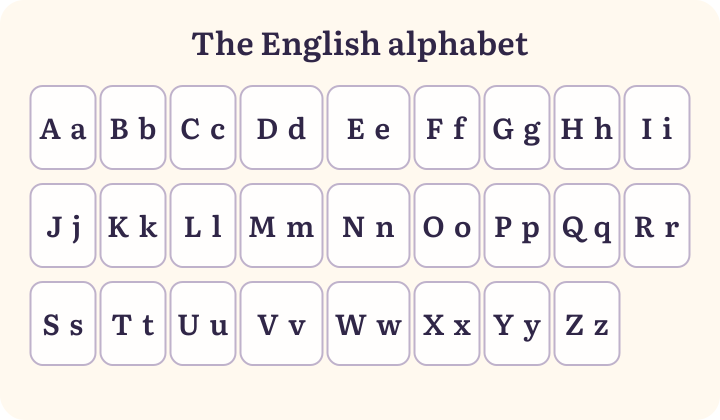
Read the chart as a shared reference
Say, “Here is B, and here is b. They are two written forms of the same letter.” Then say “boat” and glide one hand slowly, like a little boat on a pond. There is no need to cover all twenty-six entries, recite them in order or remember them afterward. You may name both forms yourself instead of asking a child to identify them.
The National Association for the Education of Young Children (NAEYC) includes alphabet books and charts among possible family activities and suggests books in the home language and English. NAEYC: everyday reading and writing invitations. Our chart and original gestures are optional family activities, not a tested reading program or a checklist of what children must do at a particular age.
- Around ages 2–3, an adult can read one word while a child listens or chooses a gesture.
- Around ages 4–5, an interested child might choose a name letter, compare its two forms or ask for another entry. These are flexible invitations, not milestones.
- The gestures use empty hands. No magnets, small pieces, climbing or special equipment is needed.
Letter names and word sounds are different
The name of B sounds like “bee,” but boat does not start with the sound “bee.” The same letter can sound different in different English words. This page gives names and whole-word examples; it does not give one universal sound rule for each letter.
Rosetta Stone’s English alphabet guide shows twenty-six uppercase/lowercase pairs, distinguishes letter names from pronunciation within words, and labels its audio examples American English. Rosetta Stone: English alphabet reference. The cues below are plain English reminders such as “ay,” “eye” and “zee,” not recordings or precise phonetic transcriptions. Read them as English cues, not as Spanish spelling.
The Spanish version uses Busuu’s letter-name approximation table and inglés.com’s explanation of English b and v for its Spanish-language pronunciation reminders. Its C/Z note also uses the Cambridge entry for C, the Cambridge entry for Z and RAE-ASALE’s account of seseo. Those references explain the limitations of Spanish respellings; they do not establish a tested learning outcome.
A–F: a small scene for each letter
Choose one entry, read its English letter-name cue, then say the whole word naturally. The cue names the letter; it does not give every sound the letter can make. A child may listen, point, copy an empty-hand action or stop.
A a · acorn
Letter-name cue: “ay.” Word to share: acorn (bellota in Spanish). Cup an empty hand like a little acorn cap; no real acorn is needed.
B b · boat
Letter-name cue: “bee.” Word to share: boat (barco in Spanish). Move a flat hand slowly across an imaginary pond.
C c · cushion
Letter-name cue: “see.” Word to share: cushion (cojín in Spanish). Pretend to fluff a large soft cushion.
D d · door
Letter-name cue: “dee.” Word to share: door (puerta in Spanish). Draw a tall door in the air, then mime opening it.
E e · envelope
Letter-name cue: “ee.” Word to share: envelope (sobre in Spanish). Press your empty palms gently together like a sealed envelope.
F f · feather
Letter-name cue: “eff.” Word to share: feather (pluma in Spanish). Float an open hand slowly downward like a pretend feather.
G–L: gardens, hats and kites
Every scene can be imagined while sitting, with hands close to your own body.
G g · garden
Letter-name cue: “jee.” Word to share: garden (jardín in Spanish). Hold one hand high and the other low to imagine two garden plants.
H h · hat
Letter-name cue: “aych.” Word to share: hat (sombrero in Spanish). Mime placing an imaginary hat on your own head.
I i · island
Letter-name cue: “eye.” Word to share: island (isla in Spanish). Draw a little patch of land surrounded by pretend water.
J j · jar
Letter-name cue: “jay.” Word to share: jar (frasco in Spanish). Round your hands around an imaginary wide jar; no glass is needed.
K k · kite
Letter-name cue: “kay.” Word to share: kite (cometa in Spanish). Trace the outline of a pretend kite flying gently.
L l · ladder
Letter-name cue: “ell.” Word to share: ladder (escalera in Spanish). Move two fingers upward in the air as pretend steps; stay on the floor.
M–R: mittens, nests and ribbons
You can describe the scene instead of asking your child to copy a gesture.
M m · mitten
Letter-name cue: “em.” Word to share: mitten (manopla in Spanish). Cover one hand with your other palm as a pretend mitten.
N n · nest
Letter-name cue: “en.” Word to share: nest (nido in Spanish). Cup both hands into a broad imaginary nest.
O o · otter
Letter-name cue: “oh.” Word to share: otter (nutria in Spanish). Fold your hands near your chest, like an otter’s tucked paws.
P p · puddle
Letter-name cue: “pee.” Word to share: puddle (charco in Spanish). Make a small oval puddle with a finger in the air.
Q q · quilt
Letter-name cue: “kyoo.” Word to share: quilt (colcha in Spanish). Trace one large square and one small square in the air, like patches on a quilt.
R r · ribbon
Letter-name cue: “ar.” Word to share: ribbon (cinta in Spanish). Draw a flowing ribbon with a slow empty-hand wave.
S–Z: socks, windows and a final zee
The example for X is box: this time the letter is at the end of the word.
S s · sock
Letter-name cue: “ess.” Word to share: sock (calcetín in Spanish). Trace a sock shape in the air, with a little corner for its heel.
T t · tent
Letter-name cue: “tee.” Word to share: tent (tienda de campaña in Spanish). Make a pretend tent roof by leaning your hands together.
U u · umbrella
Letter-name cue: “yoo.” Word to share: umbrella (paraguas in Spanish). Round one arm overhead like an imaginary umbrella.
V v · vase
Letter-name cue: “vee.” Word to share: vase (florero in Spanish). Hold empty hands around a pretend wide vase with one flower.
W w · window
Letter-name cue: “double yoo.” Word to share: window (ventana in Spanish). Trace an imaginary window frame and look through it.
X x · box
Letter-name cue: “eks.” Word to share: box (caja in Spanish). The example has x at the end, not the start. Mime opening a large box.
Y y · yarn
Letter-name cue: “why.” Word to share: yarn (estambre in Spanish). Roll empty hands slowly around a pretend ball of yarn.
Z z · zipper
Letter-name cue: “zee.” Word to share: zipper (cierre in Spanish). Mime moving an imaginary zipper up and down.
Start with a name your child knows
A familiar name can offer a reason to look at one letter. Write a chosen name on a large sheet if you have one, or point to a familiar written name in a book.
Choose a name
Choose a name your child already knows, like their own or a favorite character's. A grown-up can point to its first letter and say its English name.
Show both forms
Show the uppercase and lowercase pair on this page. Say both yourself; let the child look, point or choose the pretend word scene.
Stop when you are ready
Ask whether to hear the word again or stop. Return another time if you want; there is no completion target.
Keep English and Spanish letter names separate
The Spanish version of this page is still a guide to the English alphabet: it explains the same twenty-six English letters to Spanish-speaking grown-ups. A word translation is included to clarify its meaning, not to change the English example’s spelling or letter name.
For example, English boat begins with B, while its Spanish translation barco also happens to begin with B. That coincidence is not a rule: English hat begins with H, while sombrero begins with S. Ñ belongs to the Spanish alphabet and is not an additional letter in this English chart. You can enjoy a home-language book without translating every English entry.
A pause is part of the activity
If a child gives a different word, uses a home-language name or wants to draw instead, follow that choice or close the page. You can supply the English word without making them repeat it. Neither spelling a name nor recognizing every form is required to enjoy a pretend scene.
This guide was written and reviewed using AI tools. It has not been reviewed by an education professional or tested with children. This is a written parent resource. It contains no recorded alphabet narration or downloadable workbook.
If letters look alike, such as b and d, p and q, or capital I and small l, point to one pair and name it once. There is no need for correction drills. Your child can choose another letter, copy a gesture or stop.
Pictures and games can be another choice
Our animal-name activity offers illustrated animal names for another shared picture activity. To try a different way of sharing words, choose one of the twenty original tongue twisters. These are separate, optional activities; you do not need to add another after reading one letter.
Leelalu’s website currently offers three free browser games: Shape Match, Color Match and Big & Small. They are matching and size games, not an alphabet course. Choose them another time, or stay with this chart and one pretend scene.
Questions parents ask
How many letters are in the English alphabet?
Twenty-six. Uppercase and lowercase are forms of the same letters, so there are still 26 letters, not 52.
Are English letter names the same as their sounds in words?
No. For example, the letter B is named bee, but the whole word boat does not begin with the spoken name bee. A letter can be used differently in different words; letter names alone do not make a complete phonics lesson.
Does my child need to say the ABCs in order?
No. You can share one chosen letter, read its word yourself, listen together or stop. This page sets no age milestone or performance target.
Why can box be an example for the letter X?
The English word box has x at the end. A familiar word can show a letter in the middle or at the end; not every example has to begin with that letter.
What are the letter names in American English?
Here is a written reminder list, not an exact phonetic transcription: A (ay), B (bee), C (see), D (dee), E (ee), F (eff), G (jee), H (aych), I (eye), J (jay), K (kay), L (ell), M (em), N (en), O (oh), P (pee), Q (kyoo), R (ar), S (ess), T (tee), U (yoo), V (vee), W (double yoo), X (eks), Y (why), Z (zee). These are letter names, not rules for every sound inside words.
Keep playing together
Sources and context
- Your English Alphabet Guide With Audio To Master PronunciationAccessed · Source language: English
- Everyday Steps to Reading and WritingAccessed · Source language: English
- Abecedario en inglésAccessed · Source language: Spanish
- La pronunciación de la b y la v en inglésAccessed · Source language: Spanish
- C, c | Cambridge DictionaryAccessed · Source language: English
- Z, z | Cambridge DictionaryAccessed · Source language: English
- Seseo | Diccionario panhispánico de dudasAccessed · Source language: Spanish