A quick starting point
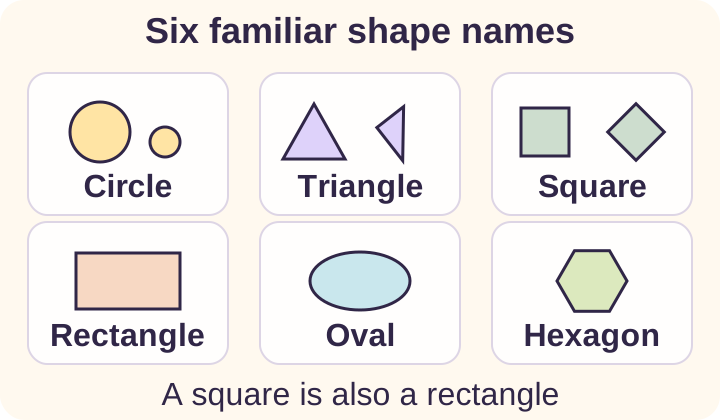
A 2D shape is a flat figure. Here are six basic shapes for kids: a circle has a round outline with no corners; a triangle has three straight sides; a square has four equal sides and four right angles; a rectangle has four right angles; our oval is an ellipse with a curved, elongated outline; and a hexagon has six straight sides. A square is also a rectangle. A circle is flat and two-dimensional; a ball is a solid, three-dimensional object.
How to use this shape picture guide
The names below each group of drawings are for you to read aloud. Point to a picture and say, “This is a circle.” Follow its curve or one straight side with your finger. Keep the chart visible so your child can point instead of remembering a name.
For the paper activities, use a whole sheet and a pencil that you handle. If your child already uses crayons and wants to draw, offer a familiar, age-appropriate chunky crayon and stay beside them. Their drawing can be their own while you draw the guide’s examples separately. No cutting or small pieces are needed. Stay with what catches your child’s attention and stop when they want to finish.
Circle: a closed round outline with no corners
Every point on a circle’s outline is the same distance from its center. A circle has no straight sides or corners. Both circles in the picture follow this rule, even though one is smaller.
Try moving your finger around one circle without stopping at a corner. A round clock face can be a familiar comparison: talk about the outline of its front, rather than calling the entire clock a circle.
Triangle: three straight sides and three corners
A triangle is a closed flat shape with three straight sides and three corners. Its sides can have different lengths. A triangle can be tall, wide, small or turned; it does not need a point at the top.
Our illustration includes a scalene right triangle: all three sides have different lengths, and one angle is a right angle. You can simply call it a triangle with a young child. Follow each straight side, then lift your finger to touch each corner.
Square: four equal sides and four right angles
A square has four straight sides of equal length and four right angles. “Square corners” is a useful everyday description of those angles; the corner of a sheet of paper can help you show one.
The picture shows two squares in different positions. Both have the same defining features. For a closer look, follow the four sides of one square and touch its four corners.
Rectangle: four right angles, with opposite sides equal
A rectangle has four straight sides and four right angles. Opposite sides have equal length. The rectangle in the chart has two longer sides and two shorter sides, but rectangles do not have to look long and narrow.
A square is a special rectangle with all four sides equal. You can use the more specific name “square” for that shape. To compare the two drawings, point to a right angle on each; then look at which sides have equal lengths.
Oval: the ellipse shown in our picture
Our oval is an ellipse, drawn wider than it is tall. An ellipse can be placed in any direction. Its outline is a smooth, closed curve with no straight sides or corners.
“Oval” is an everyday name used for several rounded, elongated outlines. This guide uses the particular ellipse in the chart. Compare its outline with the circle: the ellipse in the chart is wider than it is tall, while every point on the circle’s outline is equally far from its center.
Hexagon: six straight sides and six corners
A hexagon is a closed flat shape with six straight sides and six corners. The hexagon in our illustration is regular: all six sides have equal length, and all six interior angles are equal. Other hexagons can have unequal sides and unequal angles.
Point to one side, then move around the outline while you count the six sides aloud. A younger child can choose where you start. A drawing of a honeycomb cell is another familiar example; a real cell may have a less exact outline.
A simple start for toddlers; a challenge for preschoolers
For ages 2–3, begin with one large drawing and one action: “Here is a circle. Let’s go around it.” You can model the gesture while your child watches or points. Choose a single feature rather than asking for all six names.
For ages 4–5, an interested child can compare two outlines or explain a choice: “These triangles look different. What makes both of them triangles?” Follow the straight sides together and touch the corners. You can model the answer: both outlines are closed and have three straight sides and three corners. These are ways to adjust the activity, not milestones that every child must meet.
Four paper activities with a clear beginning and ending
Choose an activity below and keep the guide in view. You make the drawings and any additions. The younger path starts with pointing or watching; the longer path adds a choice or a reason.
Choose what goes in the window
Draw an empty rectangular frame on one part of the sheet. Before drawing anything inside, ask, “What should I draw in our window: a circle or a triangle?” Point to the two examples in the guide. Draw the chosen shape inside the frame; if your child is watching, choose one and describe it yourself. For a longer turn, ask where to add a second shape: above or below the first one. The frame and the pictures inside it are separate outlines.
Send triangles on a postcard
Draw an empty rectangular postcard frame on the left side of the sheet. Outside the frame, on the right, draw four separate closed shapes: a large triangle, a smaller triangle, a turned triangle with unequal sides, and a square. Leave space between them. Ask, “Which shapes belong on a triangle postcard?” Follow a candidate’s sides with your finger, then touch its corners. Copy the selected triangles inside the empty frame; leave the original candidates outside. All three triangles belong because each is closed and has three straight sides and three corners. The square has four sides, so it does not fit this triangle rule. For a younger child, show and name one triangle. For a longer turn, check each candidate and explain the choice together.
Close an unfinished outline
Draw two straight lines joined like a wide V, with their other ends apart. The outline is open. Ask, “Can one straight line join these two ends?” Point to the gap, then draw that line yourself. Now the outline is closed and has three straight sides: you have made a triangle. For a younger child, show the gap and then the finished triangle. For a longer turn, let your child point to where the new line will go before you draw it.
Give the grown-up a shape clue
Keep the chart in view and invite your child to choose a shape for you to draw. A younger child can point; you name the shape and draw it. For a longer turn, invite a clue instead of a name. For example, “It has no corners” could describe the circle or the oval. Draw a circle and ask, “Would our oval fit that clue too?” Yes: both have curved outlines with no corners. A clue may fit more than one picture. If your child wants help, model the clue yourself and show the matching drawings.
A flat shape and a solid object are different
The chart shows flat, 2D shapes. A solid object has depth as well as width and height. A ball is a solid object, often represented as a sphere. Its outline can look circular, but the whole ball is not a flat circle.
Keep a real-world comparison tied to one view. For example, the front of a box may have a rectangular outline. With a younger child, “This looks round” is a useful place to start; the explanation about solid objects is information for you.
Use the language your family knows
Say “side,” “corner,” “straight” or “curved” while showing that feature. Use the words your family is comfortable with; pointing and a clear example can go alongside the name.
In NAEYC’s Teaching Young Children magazine, Linda Dauksas and Jeanne White (April/May 2014, Vol. 7, No. 4) discuss varied shape sizes and orientations, mathematical vocabulary in English and children’s home languages, and comparisons of flat and solid shapes. Read their article about shapes and space. Their article offers classroom guidance; it does not evaluate this guide or show learning results from Leelalu.
More shape play on the Leelalu website
The Leelalu website has three free games: Shape Match, Color Match and Big & Small. Shape Match lets you match pictures; this guide gives families names, features and paper activities. Open the three free games.
To notice shapes, colors and sizes in things nearby, try our shape, color and size walk. That activity has separate ideas for ages 2–3 and 4–5, with its own guidance for choosing suitable objects.
This guide was written and reviewed using AI tools. It has not been reviewed by an education professional or tested with children.
Questions parents ask
Is a square also a rectangle?
Yes. A rectangle has four right angles, and its opposite sides are equal. A square has those features plus four equal sides. “Square” is the more specific name.
Does turning a square change it into a different shape?
No. Turning changes the square’s position, not its side lengths or angles. It remains a square. Every square is also a rhombus because it has four equal sides; that is true before and after a turn. People sometimes call a turned square a “diamond,” but it is still a square.
Is a ball a circle?
No. A ball is a solid object, usually represented as a sphere. A circle is flat. One view of a ball can have a circular outline, but the outline and the whole object are different.
Do we need to print the guide or finish all four activities?
No. The complete guide and illustration are on this page. Start with one picture or one paper activity. You can finish when your child is ready to stop.
Keep playing together
Sources and context
- Discovering Shapes and Space in PreschoolAccessed · Source language: English