A quick starting point
Draw a blanket, a wide arch, and a tree on a whole sheet. Start with “on the blanket.” Show the move with one plush toy, then let your child choose. Add “under the drawn arch” and “next to the tree” one at a time. A gesture can guide the toy. For “under,” place the toy on the paper, inside the drawn arch and below its top. Do not slide it under the sheet: the map and toy stay visible.
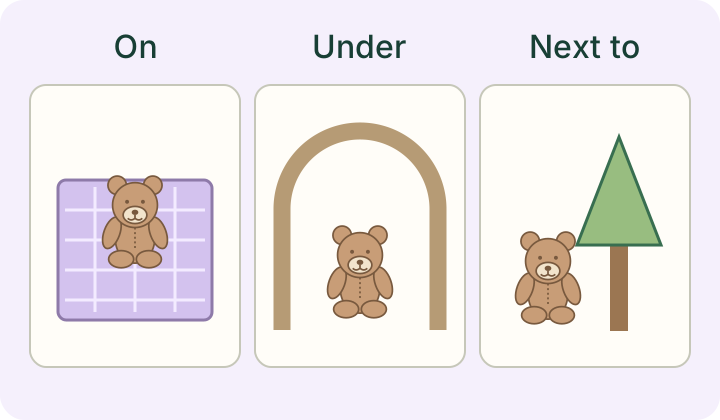
Draw three roomy places
Choose a familiar plush toy without loose parts, large enough that it cannot fit in your child’s mouth. An adult makes a simple original picture map on paper large enough for that toy. Draw a rectangle for a blanket, a broad arch with empty space beneath its top, and a tree with open space beside it.
Leave generous gaps between the drawings. The map does not need words, arrows, a scale, or realistic scenery. Keep it flat on a clear table or floor where you can sit together. You can move the toy while your child looks, points, or speaks.
Show one position before offering another
Begin with the blanket alone if three drawings feel busy. Place the toy directly over its rectangle and say, “On the blanket.” Lift the toy away and offer another turn. Repeating one position is enough.
On
Set the toy on the drawn blanket. Point to the blanket while you say, “On the blanket.”
Under
Place the toy in the picture space beneath the drawn arch’s top. Say, “Under the arch in our picture.” Keep the whole paper flat.
Next to
Move the toy beside the drawn tree, leaving a visible gap. Say, “Next to the tree.” Either side can be next to it.
Make the picture meaning clear
The arch is a drawing, so “under” means under its top within the pretend picture. The toy is not underneath the sheet or a real structure. Point along the arch’s top and then to the space below it. If that pretend relationship is confusing, use only the blanket and tree today.
IES suggests position words such as “on,” “under,” and “next to” when describing objects. IES caregiver guidance. The flat map and these examples are our original play setup. The source does not evaluate our activity or its outcomes.
Take turns giving a tiny invitation
Try a single invitation: “Next to the tree.” Pause so your child has room to decide. If the toy lands on the blanket, describe what happened: “You put it on the blanket.” Show the tree again or continue the blanket story. Avoid turning each move into a demand for the correct answer.
Your child can be the guide while you move the toy. A point to the tree may be enough; you can supply the phrase. Use a comfortable household language. In Spanish, these picture prompts can be “encima de la manta,” “debajo del arco,” and “al lado del árbol.” Saying both languages every turn is optional.
Use age as a starting suggestion
For ages 2–3, show one move at one drawn place. Repeat or narrate where the toy is. Watching, pointing, and requesting help all fit. Add a place when your child wants another visit.
For ages 4–5, try two linked invitations if wanted: “On the blanket, then next to the tree.” Keep every landmark visible and help with the sequence. Or invite your child to draw a new landmark and decide how the toy visits it. Return to a single move whenever that makes the play easier to share.
Let the toy choose its ending
NAEYC describes guided play with adult suggestions while children continue to lead. NAEYC play guidance. Neither organization has evaluated or endorsed our map game. Let your child repeat a favorite visit, change the story, or stop. The toy can rest on the blanket while you put the paper away.
For another kind of shared noticing, the existing shape, color, and size walk offers a separate printable activity. Games also has three free public browser games about shapes, colors, and sizes if a digital turn fits later. This map needs only your drawing, toy, and time together.
Questions parents ask
Does the map need labels?
No. Point to the drawings and model the phrases. Neither the adult’s invitation nor the child’s choice requires reading.
What if under the arch is unclear?
Skip it. Keep playing on the blanket and next to the tree, or describe positions in a familiar picture together another day.
Keep playing together
Sources and context
- Teaching Math to Young Children for Families and CaregiversAccessed · Source language: English
- Principles of Child Development and Learning and Implications That Inform PracticeAccessed · Source language: English